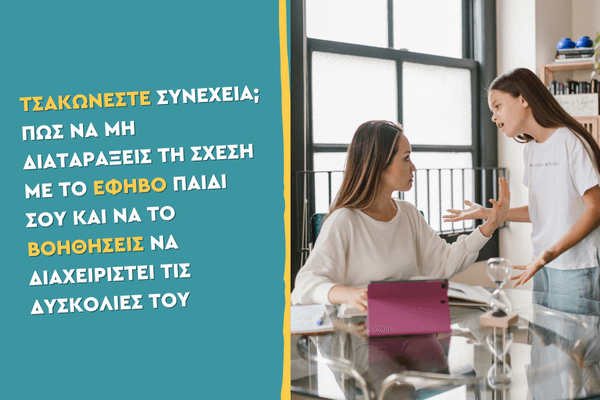
Η εφηβεία μπορεί να φέρει τα πάνω-κάτω στη σχέση γονέα και παιδιού. Παλιά μιλούσατε, τώρα δεν ανοίγει καν το στόμα του. Κάθε σας κουβέντα καταλήγει σε καβγά. Και κάπου εκεί, νιώθεις ότι χάνεις το παιδί σου.
Σε αυτό το βίντεο θα δούμε πώς μπορείς να κρατήσεις την επικοινωνία ζωντανή, να κατανοήσεις τι κρύβεται πίσω από τις αντιδράσεις του παιδιού σου και να σταθείς υποστηρικτικά, χωρίς να χαθείς μέσα στο χάος των συγκρούσεων.
Decety, J., & Jackson, P. L. (2004). The functional architecture of human empathy. Behavioral and Cognitive Neuroscience Reviews, 3(2), 71-100. https://doi.org/10.1177/1534582304267187Gordon, T. (2000). Parent Effectiveness Training: The Proven Program for Raising Responsible Children. Three Rivers PressGrotevant, H. D. (1998). Adolescent development in family contexts. In N. Eisenberg (Ed.), Handbook of Child Psychology (Vol. 3, pp. 1097-1149). John Wiley & Sons IncKobak, R., Cole, H., Ferenz-Gillies, R., Fleming, W., & Gamble, W. (2007). Attachment and emotion regulation during mother-teen problem solving: A control theory analysis. Child Development, 64(1), 231-245. https://pubmed.ncbi.nlm.nih.gov/8436031/Larson, R., & Richards, M. H. (1991). Daily companionship in late childhood and early adolescence: Changing developmental contexts. Child Development, 62(2), 284-300. https://doi.org/10.1111/j.1467-8624.1991.tb01531.xRiley, D. (2019). Positive Discipline for Teenagers: Empowering Your Teens and Yourself Through Kind and Firm Parenting. HarmonySmetana, J. G., Campione-Barr, N., & Metzger, A. (2006). Adolescent development in interpersonal and societal contexts. Annual Review of Psychology, 57, 255-284. https://doi.org/10.1146/annurev.psych.57.102904.190124Steinberg, L. (2001). We Know Some Things: Parent-Adolescent Relationships in Retrospect and Prospect. Journal of Research on Adolescence, 11(1), 1-19. https://doi.org/10.1111/1532-7795.00001